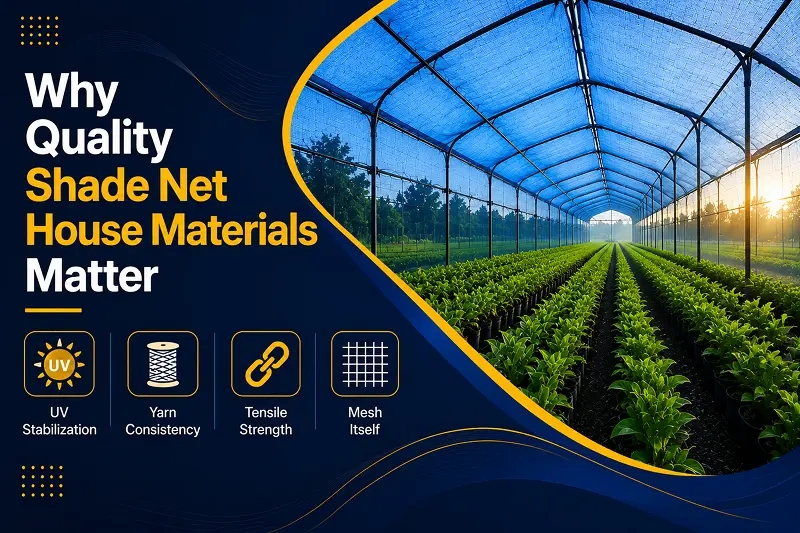
Why Quality Shade Net House Materials Matter
Shade Net House Materials
Ask any capsicum or rose grower who has used a cheap shade net for a full season, and you will get some version of the same story. First few months, it looks fine. Then the mesh starts sagging in the middle, one corner tears loose in a storm, and suddenly the "50% shade" net is behaving more like 30% in some patches and 60% in others. Nobody told the crop the net was cheap, but the crop knows anyway.
That is really what this comes down to. A shade net house is not just a roof that blocks sun — it is controlling the whole microclimate underneath: light, heat, air movement, humidity. Get the material wrong and you are not shading the crop properly, you are just filtering light unevenly while heat still builds up below.
The Label Does Not Tell You the Whole Story
Two nets can carry the exact same shade percentage on the packaging and behave completely differently after one Indian summer. The difference is usually in three places: the polymer grade (virgin HDPE vs recycled filler blend), the UV stabilisation method (extruded masterbatch vs surface spray), and the yarn denier consistency (uniform twist vs irregular flat tape).
A net made from recycled polymer with a surface UV coating and irregular tape yarn may cost 20% less today and turn into an eighteen-month net.
What to Actually Ask Before Buying
GSM and shade percentage are the easy questions — any seller can answer those. The one that actually separates a serious supplier from someone reselling stock is: how is the UV stabilisation done, and can they show you test data on it? If the answer is vague, that is the answer.
Other important questions:
- Is the yarn virgin HDPE or recycled filler?
- What is the HALS masterbatch dosage at extrusion?
- Can they provide batch test reports for GSM and tensile strength?
- What is the rated field lifespan under Indian sun conditions?
Worth the Extra Scrutiny
If a net house is protecting real income — a nursery, a flower crop, a polyhouse running on tight margins — the material holding it together deserves the same attention people already give the irrigation system or the structure itself. It is usually the cheapest-looking part of the budget and the easiest thing to cut corners on, which is exactly why it is worth not doing that.
Majestic Nets makes HDPE monofilament shade net material for horticulture and net house use, with UV stabilization built into the extrusion process rather than added as a coating. If you want actual specs before deciding, the product details are available on our website.
Shade Net House Material Quality Comparison
| Property / Feature | 100% Virgin HDPE Monofilament Net | Low-Grade Recycled / Spray-Coated Net |
|---|---|---|
| Polymer Raw Material | 100% Virgin Granules (High Molecular Chain) | Recycled Plastic Fillers & Scrap Blend |
| UV Stabilization Method | Integrated Extruded HALS Masterbatch | Surface-Sprayed UV Coating (Washes Off) |
| Shade Factor Uniformity | Precision Warp Knit (Uniform Light Spread) | Irregular Denier (Patchy Light & Heat Pockets) |
| Tensile & Burst Strength | High Tensile Strength (Handles 80+ km/h winds) | Low Break Strength (Tears under wind stress) |
| Field Lifespan | 5 to 7 Years in Indian Field Conditions | 12 to 18 Months (Chalks and degrades) |
| Net Life Cycle Cost | Lowest Cost per Year of Active Cultivation | High Replacement Cost + Crop Damage Loss |
Frequently Asked Questions
Need HDPE nets for this application?
Factory direct pricing, custom sizes and honest specs from our plant in Bhavnagar.
Get a QuoteMajestic Nets Team
Articles from the people who run the extrusion and knitting lines at Majestic Nets Pvt. Ltd.. We write the guides we wish our customers had before buying.