
Construction Safety Net Standards in India: What Site Managers Must Know
Safety netting on a construction site does two different jobs, and Indian practice treats them differently: catching people, and catching things. Knowing which net does which job is the core of compliance.
This article is a practical summary for site planning, not legal advice. Always verify current standard editions with your safety consultant.
The two net types
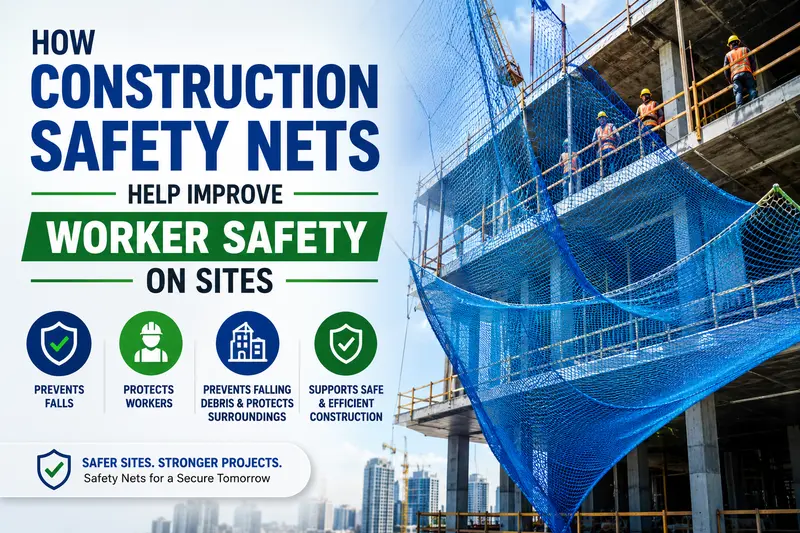
Fall protection (personnel) nets are the heavy ones: knotless construction, thicker twine, engineered to absorb the energy of a falling person. Indian practice references IS 11952 for safety nets, alongside contract specific requirements on larger projects that may cite international norms such as EN 1263.
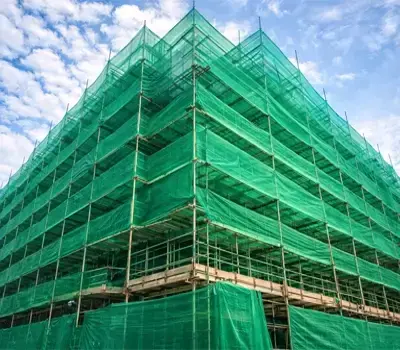
Debris containment nets are lighter, finer mesh fabric fixed on scaffolding to stop tools, offcuts and dust from leaving the structure. These are the green wraps you see on every urban high rise.
A debris net must never be used where a personnel net is required. The reverse substitution is safe but wasteful.
Comparing Personnel Safety Nets vs Debris Containment Nets
| Specification / Parameter | Personnel Safety Nets (IS 11952) | Debris Containment Nets |
|---|---|---|
| Primary Function | Arrest falling workers to prevent fatal drops | Contain falling bricks, tools, mortar & dust |
| Yarn & Twine Grade | Thick Monofilament Braided Cord (3.5 mm - 4 mm) | High-density Knitted HDPE Fabric |
| Mesh Opening Size | 50 mm to 100 mm square mesh | Fine mesh / 120 to 180 GSM shade mesh |
| Border Rope | 12 mm to 14 mm High-tensile PP/Nylon Rope | Reinforced border hem with tie ropes |
| Energy Absorption | Tested via 100 kg drop tests from 6 m height | Designed for wind drag & light impact |
What the standards care about
Across specifications, the recurring requirements are:
- Material: UV stabilised virgin polymer yarn, because a net that degrades in the sun protects no one.
- Mesh size: personnel nets commonly around 100 mm; debris netting far finer.
- Border rope and anchorage: the net is only as strong as its edge and its ties. Border ropes, corner reinforcement and specified anchor spacing matter.
- Energy absorption: personnel nets are tested by drop tests, not by feel.
- Identification: labels showing manufacturer, date and batch, so aged nets can be retired.
Installation rules of thumb
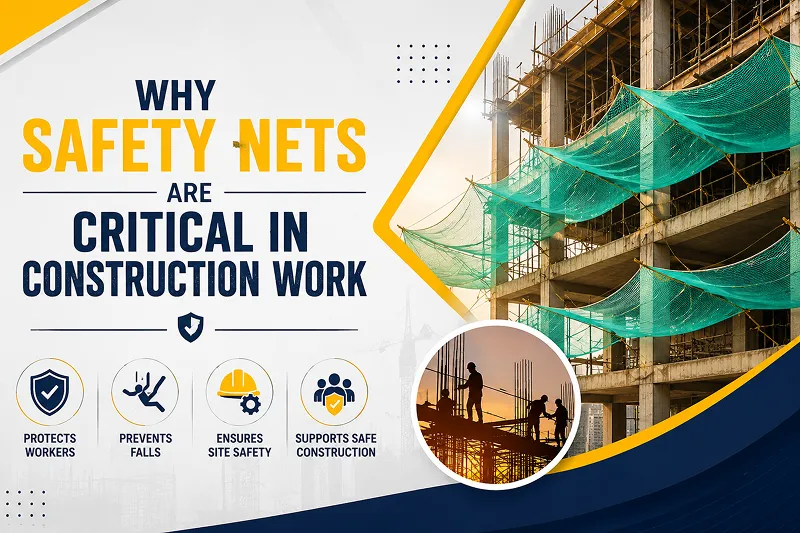
Fix personnel nets as close under the working level as possible; every extra metre of fall multiplies the impact energy. Extend the net beyond the building edge as the working height increases. Keep the clearance zone under the net empty: a net that catches a person onto stacked rebar has failed at its job. Tension debris wrap evenly on scaffolding so wind load spreads across all ties.
Inspection practice
Nets are consumables. Sites should inspect weekly for cuts, UV chalking, loose ties and burn damage from welding spatter, and after any impact event. A net that has caught a real fall is retired, full stop.
Buying for compliance
Ask your supplier for the material specification, mesh size, border details and batch test reports in writing. At Majestic Nets we manufacture safety and debris nets from UV stabilised virgin HDPE with labelled batches, and test certificates are available on request.
Specifying nets for a project? Send us the tender requirements through our quote form and we will match products and paperwork to them.
Frequently Asked Questions
Need HDPE nets for this application?
Factory direct pricing, custom sizes and honest specs from our plant in Bhavnagar.
Get a QuoteMajestic Nets Team
Articles from the people who run the extrusion and knitting lines at Majestic Nets Pvt. Ltd.. We write the guides we wish our customers had before buying.